Quick answer: A residual is a payment an actor receives when a show or film is used again after its first release: on a rerun, a cable sale, a DVD, or a streaming service. Under the union contract, the amount comes from a formula, not from how famous the actor is. For most working actors, that means residuals are modest checks. For the biggest stars, they’re a tiny fraction of the fee they negotiate up front.
What residuals are
SAG-AFTRA, the actors’ union, describes residuals as payments made for free TV, basic cable, pay cable, video/DVD, new media, and theatrical productions. The union also notes that both members and non-members earn them when they work on SAG-AFTRA contracts. In its own explainer, the union frames residuals as compensation for use of a program beyond what the initial pay covered.
Residuals go to principal performers, not to everyone on screen. And they are separate from the per-episode salaries we cover in our TV pay guide.
How residuals worked before streaming
In the broadcast era, a rerun triggered a residual check. According to Backstage’s guide to SAG residuals, payments for TV reruns start with the second broadcast and shrink with each rerun, bottoming out at 5% of the original payment by the 13th rerun. That long tail of rerun and syndication money is why some sitcom casts kept earning for decades.
Streaming changed that. A show that goes straight to a streaming service generates one annual payment rather than repeated rerun checks, a SAG-AFTRA spokesperson told Rolling Stone during the 2023 strike. Falling streaming-era residuals were one of the issues behind that strike, according to Deadline.
How a streaming residual is calculated
For big “high-budget” streaming shows, the formula has three moving parts. SAG-AFTRA published worked examples in its Streaming Residuals Gains sheet:
- Compensation, capped at a ceiling. The actor’s actual pay counts only up to a set ceiling. For a one-hour episode, the ceiling was $4,562 in the 2023 contract’s examples.
- A subscriber factor. Larger services use a higher factor. The examples use 150% for the domestic calculation and 90% for the foreign one on the biggest platforms.
- An exhibition-year percentage. The examples use 45% for year one.
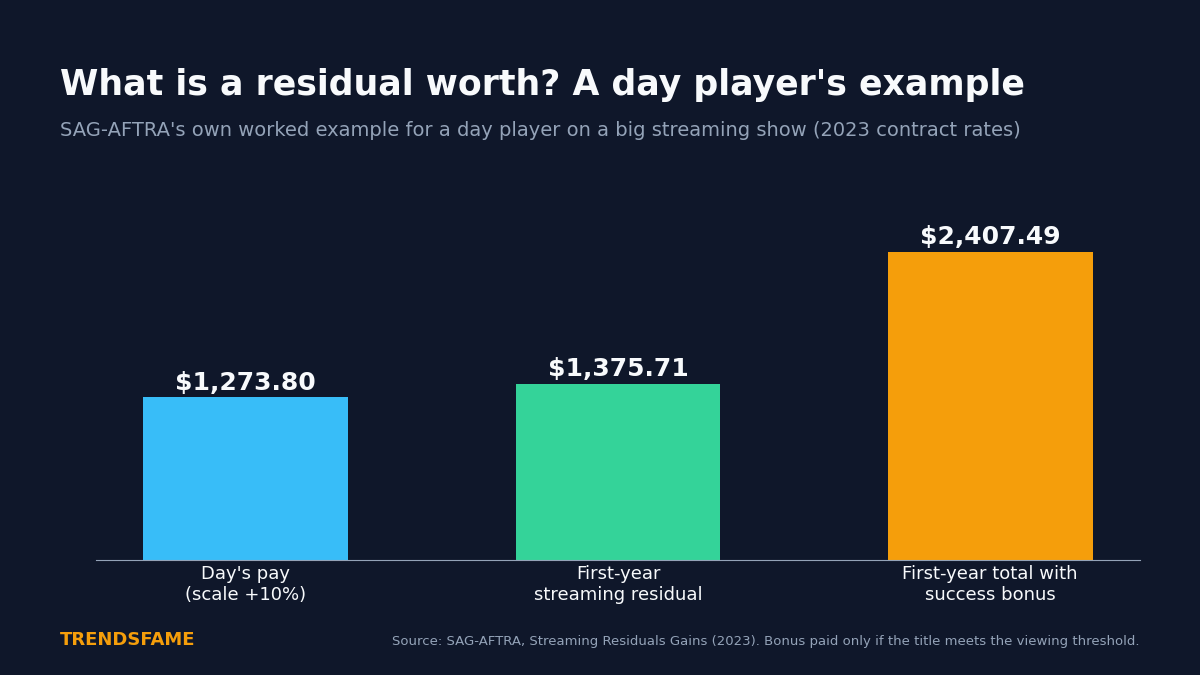
Here is SAG-AFTRA’s own example for a day player paid scale plus 10% on a show for a large service (2023 contract rates):
| Step | Calculation | Result |
|---|---|---|
| Actual pay | $1,158 scale + 10% | $1,273.80 |
| Domestic residual | $1,273.80 × 150% × 45% | $859.82 |
| Foreign residual | $1,273.80 × 90% × 45% | $515.89 |
| First-year total | $1,375.71 | |
| With success bonus | $1,375.71 + 75% | $2,407.49 |
In this example, the first-year streaming residual is larger than the day’s original pay. The figures are from the 2023 contract. Rates have risen since, so treat them as a demonstration of the method rather than today’s exact checks.
For a series regular or weekly performer on a one-hour show, SAG-AFTRA’s example works out to $4,926.96 in the first year, or $8,622.18 if the show qualifies for the streaming bonus.
The streaming bonus: who qualifies
The 2023 contract added a success bonus. Under DLA Piper’s summary of the agreement, a high-budget streaming program qualifies if it is viewed by the equivalent of 20% or more of the service’s domestic subscribers in its first 90 days. Variety reported that the union estimated the bonus would be worth about $40 million a year, with 75% going to performers on qualifying shows and the other 25% going into a jointly run fund for other members.
That is a high bar. Deadline reported in 2025 that few titles have reached it beyond the most popular ones, and that SAG-AFTRA relies on Nielsen streaming data in tracking this. The producers’ own viewing figures, per DLA Piper, are provided to the union under a confidentiality agreement and are not public.
Why residuals don’t make stars rich
Because pay counts only up to a ceiling, the residual formula treats a $750,000 episode almost the same as a much smaller one.
A hypothetical shows the effect. Take a one-hour episode with an actor paid $750,000 (the Forbes estimate for The Bear‘s lead in 2024 was that figure per episode; we use it only as a round number, not as a claim about that show’s episode length). Using SAG-AFTRA’s one-hour example, the first-year residual is about $4,927, which is roughly two-thirds of one percent of the episode fee (our calculation). Even with the success bonus, it is about 1.1%.
This is a simplified illustration. High earners can negotiate other structures, including advance-paid residuals and profit participation, and neither shows up in the formula above. Forbes reported in 2017 that The Big Bang Theory‘s stars also received a percentage of the show’s profits. For a full look at top-of-market pay, see our guide to TV actor salaries per episode.
When residuals get paid
Residuals flow from the producer to the union and then to the performer. In a TV and theatrical residuals guide the union published in 2021, payments from pay television, streaming, and digital download are due four months after initial exhibition and then quarterly. After SAG-AFTRA receives the money, it generally takes 30 to 60 days to process and send payments. Members can track them in the SAG-AFTRA residuals portal.
Kaitlin Olson Net Worth 2026: How Sweet Dee Built a $20 Million Career
What changed in the 2026 contract
Members ratified the 2026 TV/Theatrical Agreement, which runs July 1, 2026 through June 30, 2030. According to the union’s summary of the deal, the residual changes include:
- Higher minimums. Minimum pay rises 3% a year, compounded, through 2030.
- Move-over residuals. Residuals when a TV show or film moves to a subscription streamer rise by an average of 5%.
- Higher ceilings. The pay ceiling for high-budget streaming residuals rises 2.5% on July 1, 2027 and again on July 1, 2029. For a 36–65 minute program, that means $4,562 today, $4,676 in 2027, and $4,793 in 2029.
- Better foreign rates. For the largest international services, the foreign subscriber factor rises from 90% to 95% from July 1, 2026.
- A bigger bonus fund share. For qualifying titles that begin streaming on or after July 1, 2027, the amount owed to the Success Bonus Distribution Fund rises from 25% to 35% of the title’s total residuals and contributions.
- No prepaying the bonus. For performer contracts entered into on or after July 1, 2026, producers cannot prepay the success bonus.
- More transparency. Producers must provide streaming viewership data measured by the same criteria used to calculate the success bonus.
Variety and TheWrap covered the tentative deal in May 2026, including the four-year term and the merged pension plan.
How to read a “residuals” headline
- Which contract year? Rates and ceilings change. A 2023 example is not a 2026 check.
- Domestic, foreign, or both? Streaming residuals are calculated in separate pieces.
- Does it include the bonus? Most titles never qualify.
- Whose number is it? Real residual amounts are private. Anything you see about a specific actor is an estimate.
Frequently asked questions
What is a residual in acting?
A payment made when a film or TV program is used beyond what the actor’s original pay covered, such as reruns, cable, home video, or streaming.
Do actors get residuals from Netflix?
Yes, when they work on a SAG-AFTRA-covered production, streaming residuals are calculated using contract formulas. The amounts depend on the show’s budget, the platform’s subscriber tier, the performer’s pay (up to a ceiling), and the exhibition year.
Do actors get paid every time a show is rerun?
On traditional TV, reruns generate residuals that decrease with each airing, down to a floor of 5% of the original payment, per Backstage. Streaming works on an annual formula instead.
Do stars earn most of their money from residuals?
Generally no. Their income comes mostly from upfront fees and, in some cases, negotiated profit participation. The residual formula caps the pay it counts, so it adds relatively little to a very large salary.
Where can I check current rates?
The SAG-AFTRA 2026 TV/Theatrical contracts page has the current summary and rate sheets.